
liveWORK: Where Practice Begins
Before there was a residency programme, there was a way of working.
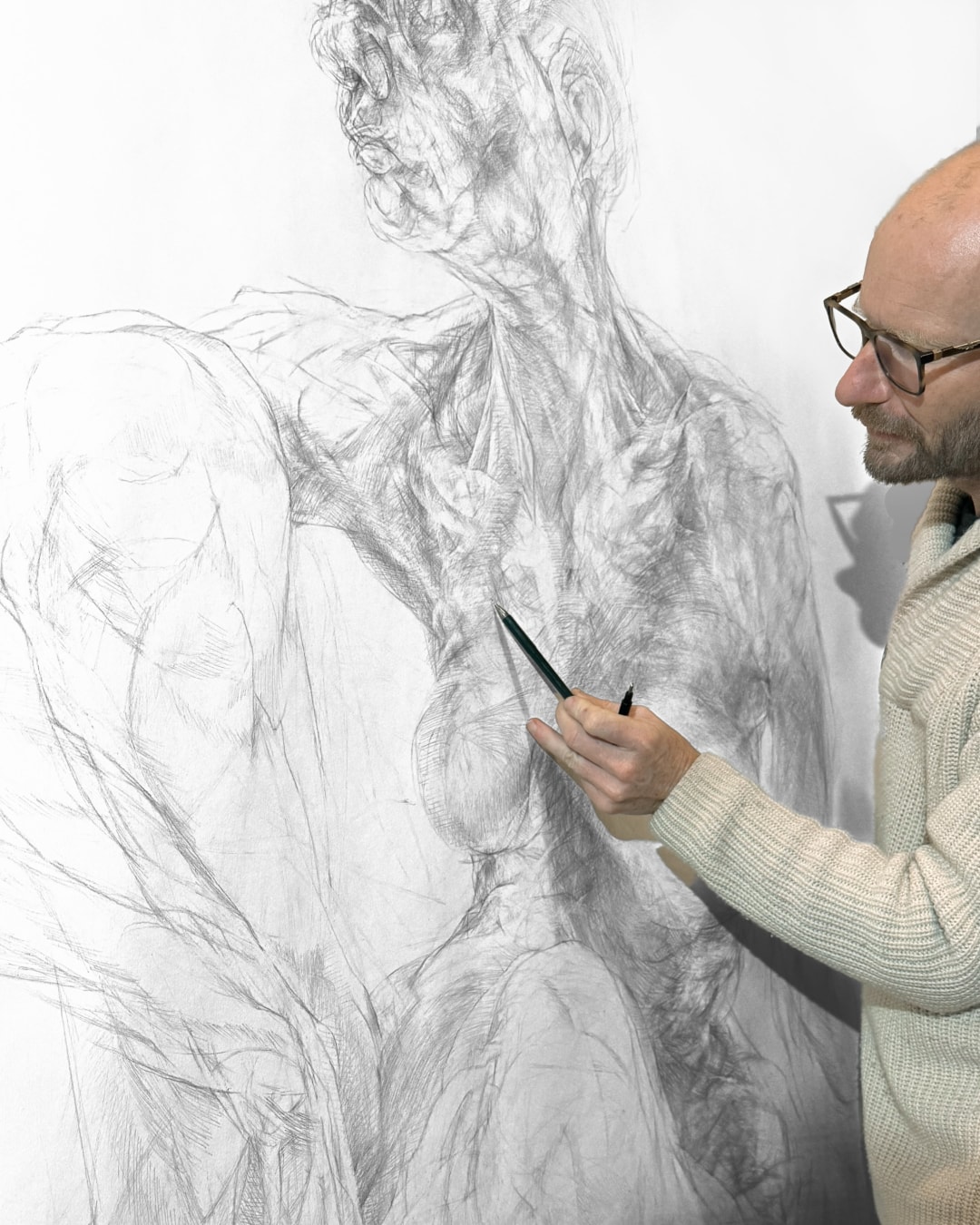
The origins of the ADMIRALS RESIDENCE begin with an artist’s studio gradually opening itself to others: conversations around drawings, shared meals after long days of work, friends becoming peers, and a house that slowly revealed its capacity to hold artistic practice.
Looking back, liveWORK marks the beginning of that trajectory. It captures the moment before a residency existed in name, when the relationship between living and working first became the organizing principle of the house.
Before There Was a Residency
Institutions often have clear beginnings: a founding date, a mission statement, a launch.
The history of the ADMIRALS RESIDENCE is less straightforward. Its origins are found in something quieter: an artist continuing to draw, a house gradually becoming more porous, and people returning not because they had been invited to an event, but because meaningful conversations kept happening there.
Long before the language of “artist residency” entered the programme, there was already a practice of welcoming artists into a shared working environment. This emerged organically through the rhythms of daily life, without the expectation that these encounters would become a formal cultural platform.
That is not unusual in the longer history of artist-led practice. Many cultural spaces begin before they are named. They begin in studios, kitchens, borrowed rooms, shared workshops and recurring conversations. Mary Jane Jacob and Michelle Grabner’s The Studio Reader reminds us that the artist’s studio has never been only a place of production; it is also a social, spatial and psychological condition through which artists understand the world they inhabit.
The house became a place where making work and living alongside it were inseparable activities. That distinction remains important because the Residence did not begin by asking how to build a programme. It began by asking, more practically, how artists might work differently if ordinary life were not treated as something outside artistic practice.
Drawing as the First Conversation
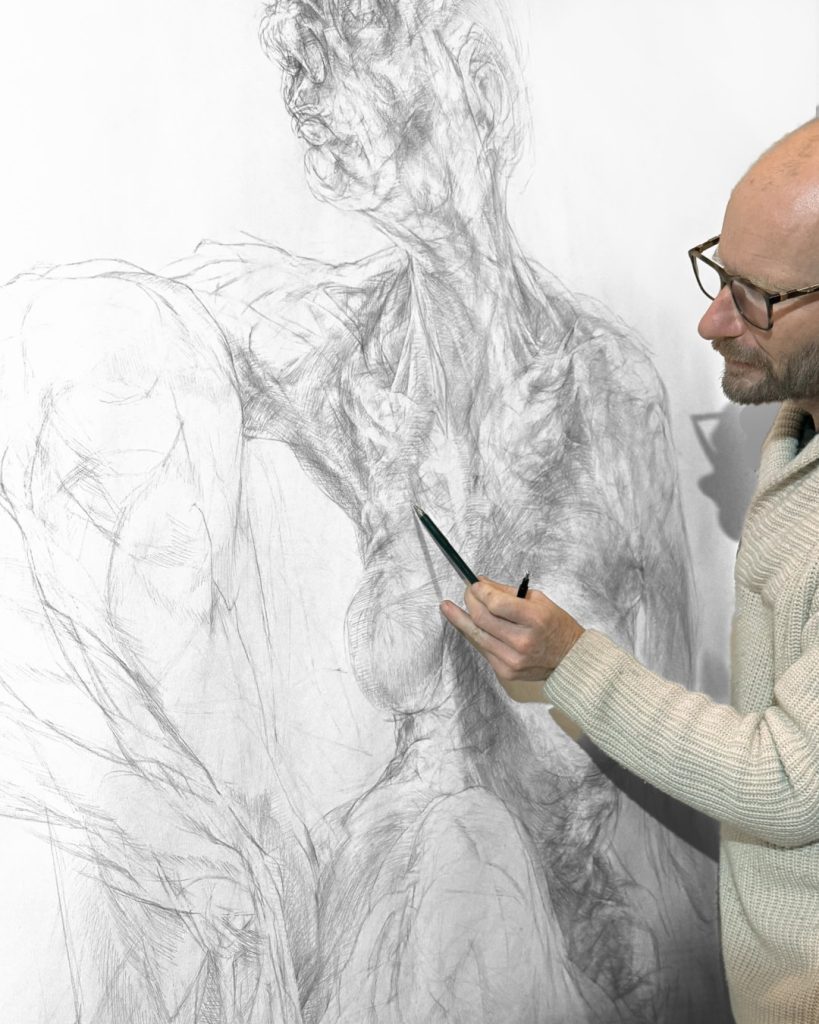
The foundations of liveWORK are inseparable from the drawing practice of artist Gerrit Handl. Drawing has always been more than a finished object. Long before it becomes an image, drawing is a way of sustaining attention.
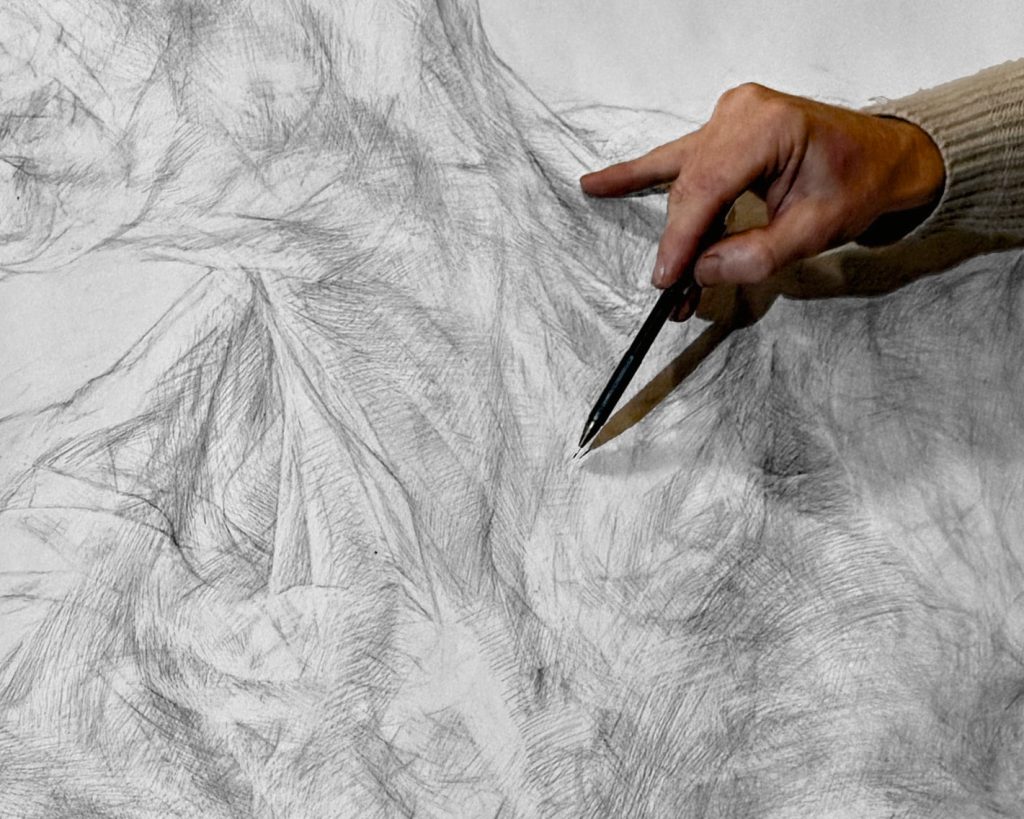
John Berger’s writing on drawing repeatedly returns to this idea: that drawing is not simply the recording of what has been seen, but an act of looking, searching and remaining with the subject over time. Tim Ingold’s work on lines widens the thought further, connecting drawing to walking, writing, weaving, storytelling and other forms of movement through the world.
Visitors entering the studio often encountered work still in progress rather than completed exhibitions. Conversations could therefore begin not with interpretation, but with process.
How long had this drawing been developing?
Why had another one been abandoned?
What changes after returning to the same image over weeks or months?
These were practical questions. They did not arrive wearing academic shoes. Yet they revealed something significant. When artistic work remains visible during its making, it invites a different kind of attention. The emphasis shifts away from completion and toward practice itself: the hesitation, the return, the small correction, the irritation of looking again when one had rather be finished. In this sense, the studio became the first public room of the house, even before it was publicly understood as such.
A Domestic Scale
The setting shaped these conversations as much as the artwork.
Unlike institutions designed specifically for exhibition or production, the house retained its domestic character. Meals were prepared in the same kitchen used every day. Visitors moved between the studio, dining room and garden. Discussions continued while making coffee or walking to the beach. The boundaries between hospitality and artistic exchange remained intentionally indistinct.
This domestic scale proved important. Rather than reducing seriousness, it often encouraged a different kind of openness. Ideas could be tested before they became public. Artists spoke about difficulties alongside achievements. Visitors encountered practice as something lived rather than presented.
But the domestic should not be mistaken for the effortless.
A house does not become generous by atmosphere alone. It is made through labour: cooking, cleaning, arranging chairs, opening doors, remembering preferences, washing glasses after everyone has gone home. Mierle Laderman Ukeles’s Manifesto for Maintenance Art remains useful here because it challenged the old division between creative work and maintenance work, insisting that care, repetition and upkeep are not outside culture but part of what sustains it. At THE ADMIRALS RESIDENCE, this matters. Hospitality is not decoration around the “real” artistic event. It is one of the quiet mechanisms through which attention becomes possible. Only later would it become apparent that these recurring patterns constituted a distinctive way of working.
Living and Working
The title liveWORK reflects a practical arrangement and suggests that artistic practice does not begin only when someone enters a studio, nor does it end when they leave. Observation continues while walking. Questions remain present during conversation. Ideas often develop around the dinner table as readily as they do at the drawing board.
This understanding gradually informed the wider culture of the house. It did not dissolve the distinction between life and work in a romantic sense. Artists still need solitude. Work still requires discipline. A kitchen is not a studio simply because an artist is standing in it.
The point is more specific: life and work continually inform one another. The walk to the sea changes the eye. A conversation at lunch changes the problem. A half-finished drawing seen in bad afternoon light suddenly gives away what it has been refusing all week. These are small things, but artists tend to know their seriousness. For a residency, this can be significant. A residency is not simply a place to produce objects. It is an environment that shapes attention, routine and relationships. The conditions surrounding artistic practice become part of the practice itself.
Looking Back
At the time, liveWORK described an existing reality rather than announcing a future programme, only in retrospect does its significance become clearer.
Many of the principles that now guide THE ADMIRALS RESIDENCE were already present in embryonic form:
the value of protected time;
the importance of sustained observation;
the role of hospitality in supporting dialogue;
and the belief that artistic practice benefits from remaining connected to everyday life.
In South Africa, this kind of gradual formation has particular resonance. Much of the country’s cultural infrastructure has been shaped by artists, educators and organizers building the conditions they needed before those conditions were properly recognized. Greatmore Studios in Cape Town and the Bag Factory in Johannesburg both stand as important examples of artist-centred spaces where studio work, exchange, exhibitions and debate formed part of a broader ecology of support. Greatmore has been described as one of Cape Town’s few active non-commercial art spaces, while Bag Factory’s programme explicitly combines art making, cultural debate, exhibitions, residencies and international exchange.
THE ADMIRALS RESIDENCE does not claim equivalence with these histories. It simply recognizes that it is working in a country where artistic infrastructure has often had to be made before it could be named.
These ideas have developed gradually through repeated experience, shaped as much by artists who visited the house as by those who lived there. Recognizing this continuity is about understanding it more accurately.
An Ongoing Practice
Today, the Residence has grown beyond the circumstances from which liveWORK emerged. Residencies, exhibitions, salon dinners and public programmes now provide additional ways for artists and audiences to engage with the house and its underlying principles.
The current institutional language of the Residence names those principles more clearly: protected time, spatial clarity, hospitality, conversation, observation, proximity, interruption, documentation and institutional memory. What has changed is not the basic instinct, but the ability to recognise and articulate it.
This is where memory becomes part of the work. Archives are not made only from finished exhibitions and official documents. As Diana Taylor has argued in another context, cultural memory is also carried through embodied practices, repetitions, gestures and forms of transmission that do not always sit neatly inside the archive. Hal Foster’s writing on the archival impulse is equally useful here, not because the Residence is claiming to be an archive in the grand sense, but because it is beginning to understand that fragments, conversations and repeated gestures need to be held before they disappear.
The programme still begins with practice rather than programming. It still values conversation that develops through time. It still understands hospitality as part of the cultural environment rather than an activity separate from it. Looking back, liveWORK was never simply the name of an early project. It described a way of inhabiting artistic practice that continues to shape THE ADMIRALS RESIDENCE today. In that sense, it is less a historical chapter than the first page of an ongoing editorial record.
Sources Referenced
Berger, John. Berger on Drawing. Occasional Press.
Foster, Hal. “An Archival Impulse.” October, vol. 110, 2004.
Jacob, Mary Jane, and Michelle Grabner, eds. The Studio Reader: On the Space of Artists. University of Chicago Press, 2010.
Ingold, Tim. Lines: A Brief History. Routledge, 2007.
Taylor, Diana. The Archive and the Repertoire: Performing Cultural Memory in the Americas. Duke University Press, 2003.
Ukeles, Mierle Laderman. Manifesto for Maintenance Art 1969!
Leave a Reply